Meet the Third Class of Post-Conviction Litigation Fellows
These three fellows are excited to bring their unique experiences and deep commitment to post-conviction work and racial justice.
04.02.26 By Ishikaa Kothari

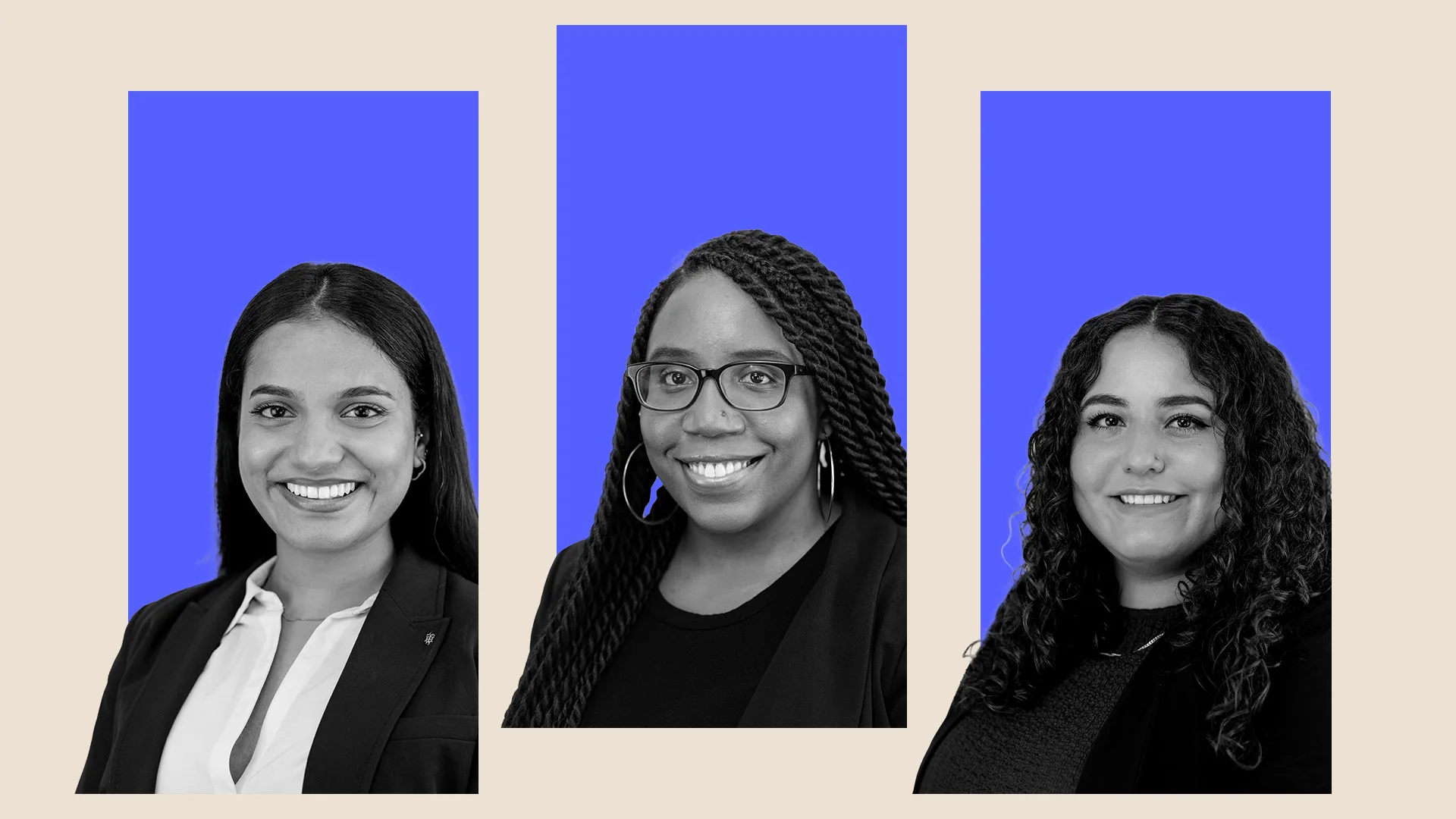
From left to right: Kayla Martin, Christina Williams, and Bella Cooper. (Image: Innocence Project/Mia Ossandon)
The Innocence Project’s Post-Conviction Fellowship program is one of the few in the country that trains early career attorneys in post-conviction litigation. For two years, fellows work alongside Innocence Project staff attorneys — conducting rigorous case reinvestigations, drafting persuasive court filings, and connecting with clients who are seeking to prove their innocence.
“Fellows have helped reinvestigate decades-old cases, developed compelling arguments, and won motions for relief from conviction,” PCL Fellowship Director Jane Pucher added. “Most importantly, they have built strong client relationships and made a lasting impact on their clients’ lives.”
Robyn Trent Jefferson has served as a cornerstone of the fellowship, supporting several classes of fellows as a paralegal and witnessing their transformation from new attorneys into powerful advocates.
“Being afforded the opportunity to contribute meaningfully to this important work as part of this fellowship since its inception working with teams of brilliant, dedicated attorneys, has been the richest experience I’ve had in my many years as a career paralegal,” said Ms. Trent Jefferson.
The latest class of Post-conviction Litigation Fellows — attorneys Kayla Martin, Bella Cooper, and Christina Williams — joined last September and will complete their fellowships in Fall 2027.

Kayla Martin, PCL Fellow
“I have a client now who I talk to pretty much every Friday… I think because of how long post-conviction work takes, it allows you to build deeper connections with clients,” said Ms. Martin. “Knowing that I am part of their support system on the outside fighting for them no matter how long it takes is extremely rewarding.”
Ms. Martin, who is from Maryland, first developed an interest in racial justice and the criminal legal system in high school as an intern at Tandem Sports and Entertainment. While helping to organize an event with NBA player Wayne Ellington, Jr. against gun violence, she spoke with youth from underserved communities about chronic overpolicing, racial bias in the criminal legal system, and the disproportionate effect it was having on their neighborhood.
Shocked by these conversations, she worked to deepen her understanding of the criminal legal system as a criminology major at the University of Pennsylvania and then at the Charles Widger School of Law at Villanova University. Ms. Martin worked for the Public Defender Service for the District of Columbia and a post-conviction attorney during her second year of law school. She also served as a student attorney for incarcerated individuals seeking compassionate release as part of the Caritas Clemency Clinic.

Bella Cooper, PCL Fellow
Ms. Cooper’s journey was slightly different. Growing up in Berkeley, California, in a family of criminal defense attorneys, discussions about the criminal legal system were common. However, it was when she started learning about the death penalty in middle school that she became passionate about the law and began to develop a deep commitment to racial justice.
“I just couldn’t wrap my head around why we would have this form of punishment. I didn’t understand it for economic reasons. I didn’t understand it for moral reasons. So I took a deep dive into learning more about it,” said Ms. Cooper.
She went on to write her economics thesis on racial bias in death penalty sentencing in Harris County, Texas, at Stanford University. Later, at Stanford Law School, Ms. Cooper researched death penalty abolition as an informative model for police abolition. She also interned with Phillips Black, a nonprofit that provides legal representation to incarcerated people predominantly on death row, and the ACLU Capital Punishment Project. After graduating, she worked for the Office of the State Public Defender in California, writing appeals for individuals sentenced to death in California and litigating challenges to death sentences under the Racial Justice Act.
Like both Ms. Martin and Ms. Cooper, Ms. Williams was also inspired to fight injustice at an early age. Born and raised in West Philadelphia, Ms. Williams went on to attend Clark Atlanta University (CAU), a historically Black university — where she founded a voting rights coalition, called CAU Votes, to help HBCU students across Georgia vote and have their voices heard. Ms. Williams’ community organizing experience informed her desire to attend law school and focus on reducing the harm of the criminal legal system on marginalized communities.

Christina Williams, PCL Fellow
“I know that the law is often used as a weapon against communities like the one that I come from but not necessarily as a tool that they have to protect themselves,” Ms. Williams said. “I came into law school wanting to act as a sort of bridge or a translator between the power of the law and the communities it is so often wielded against … if I can get into these spaces and understand the language of how laws are written to harm us, I can translate that back to our communities to help us.” Ms. Williams attended Harvard Law School, where she participated in her law school’s Institute to End Mass Incarceration, and represented indigent individuals charged with criminal offenses through the Criminal Justice Institute. Christina also interned at the Abolitionist Law Center in Philadelphia, civil rights law firm Brown, Goldstein & Levy in Baltimore, and the Federal Public Defender’s Office in Washington D.C., before joining the Innocence Project.
When her client learned that Ms. Williams attended an HBCU in Georgia and understood firsthand the racial dynamics of the deep South, where he is incarcerated, her client wrote, “[That] simply makes my heart smile because I know: you understand us, you understand the battle, and you know the struggles.” This heartfelt moment reminded Ms. Williams of why she is so deeply drawn to post-conviction work — to stand with her community and fight deep racial bias and injustice within the criminal legal system.
Innocence Project’s fellowship program is also helping to train the next generation of post-conviction litigators.
Last September, a fellow from the previous cohort, Shabel Castro, joined the Innocence Project as a staff attorney. As someone who came into the work as an immigration lawyer, Ms. Castro appreciates her exceptional mentors for helping to ground her in post-conviction work.
“The fellowship sharpened me as a practitioner in concrete ways,” said Ms. Castro. “Perhaps most profoundly, the fellowship deepened my understanding of the power of storytelling in this work. I learned that our clients are not passive subjects of their cases — they are experts in their own experiences and must be centered as the driving agents of their own pursuit of justice. The fellowship showed me the full reality of this work — its challenges and its triumphs — and taught me that you have to make space for both.”
To learn more about career opportunities at the Innocence Project, visit www.innocenceproject.org/careers.


Leave a Reply
Thank you for visiting us. You can learn more about how we consider cases here. Please avoid sharing any personal information in the comments below and join us in making this a hate-speech free and safe space for everyone.