Six Trials, One Unbroken Spirit: What Curtis Flowers’ Story Teaches Us About Criminal and Racial Justice Reform
As the innocence community mourns the loss of Curtis Flowers, his legacy reminds us that the fight for criminal and racial justice reform remains as urgent as ever.
Op-Ed 10.16.26 By Ashley Burrell
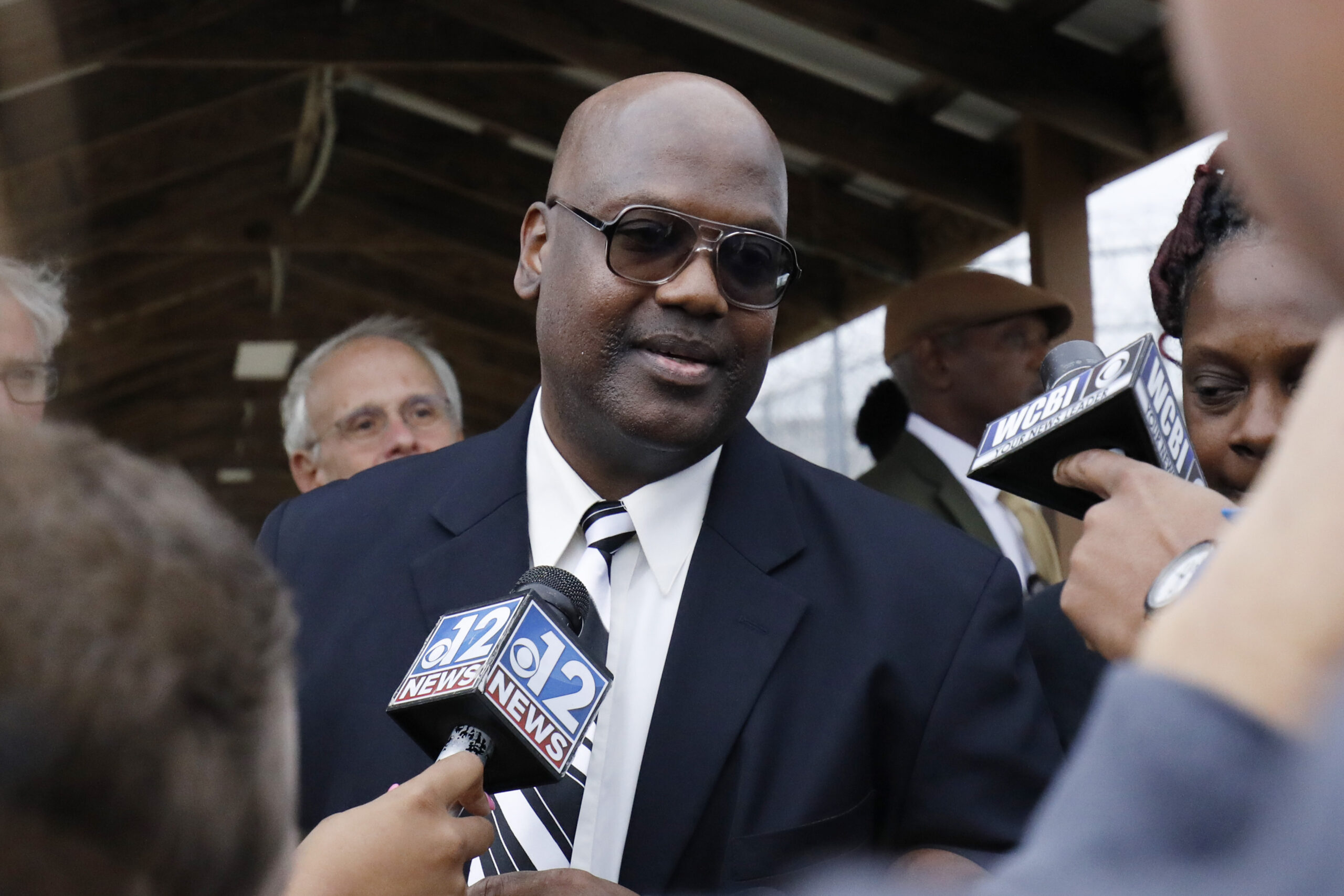
Curtis Flowers speaks with reporters as he exits the Winston-Choctaw Regional Correctional Facility in Louisville, Miss. (Image: Rogelio V. Solis for the Associated Press)
Curtis Flowers passed away last week at his home in Winona, Mississippi, leaving behind his daughter, four sisters and brother, extended family, and countless friends and supporters. He was just 56 years old. A Black man born and raised in Mississippi, Mr. Flowers endured six trials, four death sentences, and nearly 23 years in prison for a crime he did not commit. His widely publicized case became a prime example of prosecutorial misconduct and a powerful reminder that racial discrimination persists in jury selection.
In 1997, Mr. Flowers, a 26-year-old with no criminal record, was wrongfully accused and charged with the murders of four individuals at a furniture shop in Winona where he had previously worked. He was tried by Doug Evans, a white district attorney for Mississippi’s Fifth Judicial District, based on circumstantial and discredited evidence. District Attorney Evans, whose office routinely struck Black prospective jurors across the district at disproportionate rates — striking nearly 50 percent of Black prospective jurors compared to 11 percent of white jurors — applied that same egregious tactic in every single one of Mr. Flowers’ six trials.
At Mr. Flowers’ first trial, an all-white jury deliberated for just 66 minutes before convicting him of one of the murders and sentencing him to death. His conviction was reversed after the Mississippi Supreme Court found numerous instances of prosecutorial misconduct. Mr. Flowers’ second and third trials also resulted in wrongful convictions handed down by nearly all-white juries (11 white jurors and one Black juror). Once again, the Mississippi Supreme Court reversed the convictions, citing prosecutorial misconduct in the second trial and racially discriminatory practices during jury selection in the third.
Despite District Attorney Evans’ persistent manipulation of the jury pool, not all of Mr. Flowers’ trials resulted in convictions. Notably, the district attorney failed to secure a conviction when more than one Black juror was seated. In Mr. Flowers’ fourth and fifth trials, the juries were more diverse — seven white and five Black jurors in the fourth, and nine white and three Black jurors in the fifth — and both deadlocked, resulting in mistrials.
At Mr. Flowers’ sixth and final trial in 2010, District Attorney Evans exercised peremptory strikes to remove five out of the six prospective Black jurors; engaged in disparate questioning of Black and white prospective jurors; and removed a Black prospective juror who was similarly qualified as the white prospective jurors who were not struck. A jury of 11 white jurors and one Black juror found Mr. Flowers guilty and sentenced him to death. By then, Mr. Flowers had spent 13 years in an 8-by-10-foot cell at Mississippi’s notorious Parchman Prison — leaning on his family and especially his mother, Lola, for support. He once described his experience there as “the worst dream you’ve ever had, and you double that.”
It would be nine years after that final trial, that Mr. Flowers’ appeal made its way to the United States Supreme Court. At the heart of the case was whether during Mr. Flowers’ sixth trial, the prosecution impermissibly removed Black prospective jurors in violation of Batson v. Kentucky, a 1986 Supreme Court ruling prohibiting racially discriminatory peremptory challenges. In a 7-2 decision, the court reversed the conviction, ruling that the prosecution’s “relentless, determined effort to rid the jury of [Black] individuals strongly suggests that the State wanted to try [Mr.] Flowers before a jury with as few [Black] jurors as possible, and ideally before an all-white jury.”
In reversing Mr. Flowers’ conviction, the Supreme Court reinforced what we, at the Innocence Project, have observed in our cases — that the right to serve on juries has remained largely illusory for Black Americans, directly contributing to their disproportionate rate of wrongful convictions. Upon this country’s founding, Black people were denied the right to serve on juries because the Constitution legally classified enslaved people as property rather than citizens. Even after they were granted citizenship under the Civil Rights Act of 1866 and the Fourteenth Amendment, they were largely excluded from jury selection post-Reconstruction through the mid-twentieth century. While the Supreme Court’s decision in Batson v. Kentucky was meant to end this practice by prohibiting attorneys from removing potential jurors based on race, discrimination in the jury box, as seen in Mr. Flowers’ case, has gone unchecked.
Research shows that non-diverse juries impact the reliability and accuracy of the deliberation process and, ultimately, the likelihood of a wrongful conviction. It has also been shown that compared to representative juries, all-white juries spend less time deliberating, consider fewer perspectives, and make more mistakes. Research also reveals that all-white or nearly all-white juries are more likely to associate Blackness with criminality (whether overt or implicit), and are, therefore, more likely to convict the accused when they are Black. Conversely, diverse juries are more likely to hold the prosecution to their burden of proof and discuss topics, such as racial profiling or stereotyping, that are often overlooked by all-white or nearly all white juries.
While Mr. Flowers was eventually exonerated in 2020 after the Mississippi attorney general moved to dismiss the charges against him, District Attorney Evans was never held accountable for his actions. He remained the Fifth Judicial District’s chief prosecutor until his retirement in 2023.
In the remaining six years of his life as an exonerated man, Mr. Flowers became a powerful voice against a criminal legal system rife with racial bias and discrimination — and the prosecutor who enabled his conviction. In a 2021 interview with 60 Minutes, he told investigative reporter Sharyn Alfonsi, “I believe every case Doug Evans ever handled should be looked into. I truly do. Lord knows I would hate to see this happen to someone else.”
It is this story of a gross miscarriage of justice — and Mr. Flowers’ courage against all odds — that propels us to confront racial bias in our criminal legal systems. We owe it to him, his family, and the greater community to do better.
Curtis Flowers was represented by Keir Weyble and Sheri Johnson from the Cornell Law School Death Penalty Clinic; Alison Steiner; Hogan Lovells; Tucker Carrington of the George P. Cochran Innocence Project at the University of Mississippi School of Law; the Mississippi Office of Post Conviction Counsel; Rob McDuff; and Henderson Hill.
Leave a Reply
Thank you for visiting us. You can learn more about how we consider cases here. Please avoid sharing any personal information in the comments below and join us in making this a hate-speech free and safe space for everyone.