How Yosha Gunasekera’s Fight to Free the Innocent Shaped Her Murder Mystery Novel ‘The Midnight Taxi’
In her new novel, this Innocence Project attorney challenges readers to look at the criminal legal system in a different way.
02.11.26 By Louise Liu
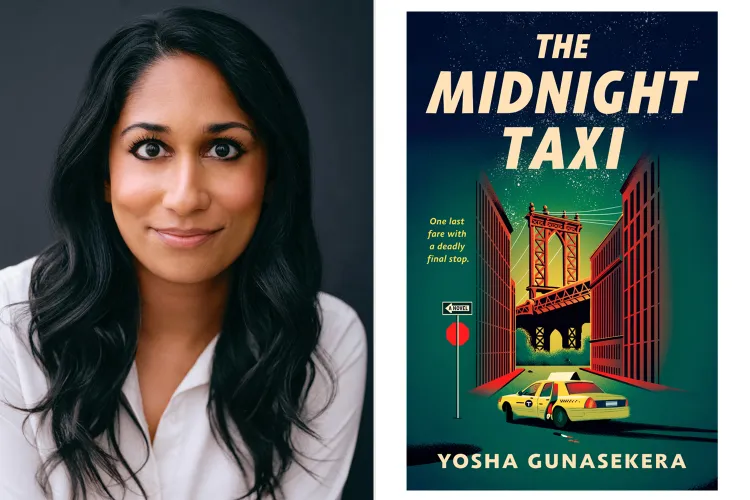
Image: Sub/Urban Photography; Berkley
Between court hearings and client meetings, attorney Yosha Gunasekera scribbled stories in a yellow legal pad, never imagining those pages would one day become a published murder mystery. Her days were devoted to drafting briefs, not fiction — first as a public defender at the Legal Aid Society, and now as a staff attorney at the Innocence Project, where she fights to free the wrongfully convicted. But in stolen moments, she returned to her legal pad again and again, until eventually, a novel emerged from the scrawl.
Her debut novel, The Midnight Taxi, published this February and named one of New York Times’ best new mysteries, follows Siriwathi — or Siri, for short — a Sri Lankan American taxi driver on a race across New York City’s five boroughs, chasing clues that might clear her name after she is wrongly accused of murdering a passenger. The novel is a love letter to immigrants, service workers, and the city’s hidden corners — and an homage to the innocent men and women she represents in court.
In a recent interview, Ms. Gunasekera reflects on her writing journey, her life-changing work at the Innocence Project, and the painful impact of wrongful convictions on families and communities.
You explain in the acknowledgements that the idea for this book originated in a taxi cab. Can you tell us a bit about that, and why you use a taxi driver as a medium to tell this story?
One night, I was leaving court and getting ready to flag down a taxi or call a rideshare, but a yellow cab was already waiting there. The taxi driver was someone who frequently waited outside of New York County Criminal Court at 1 a.m. because he wanted to hear the stories of people who had been inside. We ended up having this really lively conversation. It was this rare moment of human connection.
Taxi cab drivers are essential New York City service workers who we often just have fleeting interactions with — we’re all so busy running to get to our next place. There’s a part of what is affectionately known as “Curry Hill” — a three-block stretch of midtown that is lined with exceptional South Asian restaurants — where drivers wait for a late night cup of coffee to fuel their rides. I would see them there late at night, people who very much looked like me, whose stories I always wondered about.
I also ended up marrying into a family of cab drivers. My husband’s father and grandfather drove cabs. And his grandfather actually got shot in the head while driving, lived to tell the tale, and went back to driving a cab. But I just thought, how can I explore New York City with a character that is really important to the lifeblood of the city?
You make the decision to explore Siri’s Sri Lankan identity, through food, family, and connection. Can you tell us what role culture and the immigrant experience played in writing this story?
Growing up, I loved reading murder mysteries, but there was never a protagonist that looked like me — South Asian or Sri Lankan American. I wanted this book to be a nod not only to my own heritage, but also to the amazing, rich cultural heritage of New York City. There’s such a rich Sri Lankan American population and culture here that so few people know about. It was such a delight to be able to reference real restaurants and real places in the city. Two of my favorites are Lakruwana and New Asha in Staten Island.
At the Innocence Project, you act as a staff attorney and supervisor of intake strategic initiatives, where one of your jobs is to represent people who have spent years — if not decades — incarcerated for crimes they didn’t commit. How has your work shaped The Midnight Taxi?
My work at the Innocence Project heavily impacted this book. The legal system is biased against people of lower socioeconomic means. It is a racist system that affects certain people much more severely than others. There are a lot of issues that people aren’t aware of that I wanted to bring to the forefront in my writing.
There is a scene in the novel where the authorities essentially try to coerce Siri into giving a false confession, which is something we see regularly in our cases — people who are actually innocent, who confessed to a crime that they didn’t commit. As much as I wanted to write a book that was entertaining and fun, I still wanted to include important social justice themes. Though you have to suspend your disbelief at certain times, I wanted people to understand that the criminal legal system doesn’t necessarily operate the way you see on TV or social media. Sometimes, when we look at fictionalized versions of how the criminal legal system works, it’s presented as a much more fair and equal place, when in reality it’s deeply prejudiced against people who have been accused of crimes.
You take great care to make Siri relatable, and humanize those who have been wrongfully accused. What did you want people to take away from the book?
I wanted the book to help people challenge their assumptions about what happens when someone has been arrested. People are innocent until proven guilty, and unfortunately, we’ve found people are innocent even after being proven guilty. I wanted to challenge readers to look at the criminal legal system in a different way, to understand that the system isn’t infallible.
With Siri, she’s arrested as the obvious and only suspect. The police fail to investigate anyone else so the whole investigation immediately points towards her. And we see that in so many of our cases.
People also don’t realize the huge information disadvantage that public defenders — or any criminal defense attorney — have at the onset of a case. Information is kept from individuals who want to investigate their own case.
You have a powerful way of depicting the impact that the criminal legal system has on communities, particularly through Siri’s concern about how being wrongfully accused could affect her family and loved ones. What did you learn about yourself, your clients, and community while writing this book?
In writing the novel, I imagined what it would be like to be someone ensnared in a system that is conspiring against them at every turn. I thought about the fear that someone must feel when they are arrested, especially when they’re innocent, and the loneliness and isolation of being removed from one’s friends, family, and community. It made me reflect upon not only the pain that someone’s loved ones feel when they are incarcerated, but the impact of their loss on their entire community.
I thought of my clients — all the years lost, all the holidays missed, births and deaths told only over the phone — and I tried to channel some of that into Siri.
How has writing this book impacted your work to free the innocent, if at all?
It’s been the other way around. My work at the Innocence Project is the most important thing that I do, and it impacts everything I do. I think about my clients constantly — they are the most incredible, resilient, amazing people. They impact my writing, my work, and frankly, they impact my life, day to day. My work has ultimately made me a better writer, and it’s made me a more thoughtful human. I’m really, really grateful for that.
*This Q+A was edited for clarity.

Leave a Reply
Thank you for visiting us. You can learn more about how we consider cases here. Please avoid sharing any personal information in the comments below and join us in making this a hate-speech free and safe space for everyone.