Eric Kelley
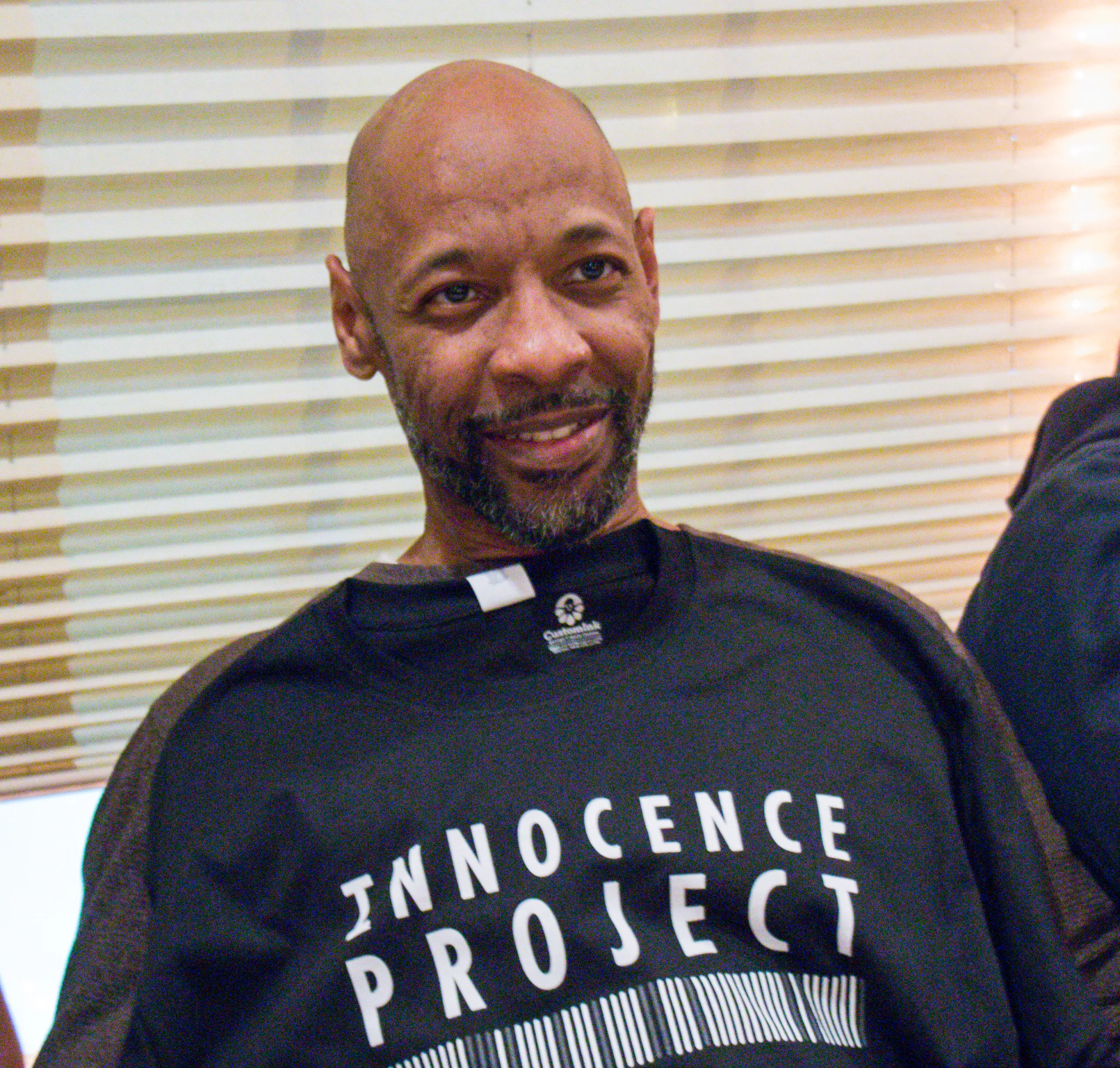
On April 6, 2018, Eric Kelley and Ralph Lee were exonerated in Passaic County, New Jersey, of a 1993 murder and robbery after DNA tests identified the actual perpetrator. Mr. Kelley and Mr. Lee spent more than 20 years in prison for a crime they did not commit.
The Crime
On July 28, 1993, 22-year-old Tito Merino, a Peruvian immigrant, was working at Victoria’s Videos, a store owned by his uncle in Paterson, New Jersey. The store rented videos and sold cameras, videocassette recorders, car radios, and similar items. Shortly before 1 p.m., Mr. Merino was seen standing on a chair tinkering with the store air conditioner. At 1:45 p.m., he was found stabbed to death at the rear of the store. The cash register was open and empty.
The Investigation
An inventory revealed that about $150 in cash was missing, as well as a videocassette recorder, three car radios, and five watches.
The following day, Carmen Paredes told police she had stopped in the store at about 1:20 p.m. on the day of the crime, and almost bumped into a Black man wearing a backwards green baseball cap. She viewed a book of police mug shots, but was unable to identify anyone.
Another customer, Majdi Mousa, told police that he had gone to the store at about 1:30 p.m. to return a video. A Black man had emerged from the back of the store and told Mr. Mousa to put the video on the counter and leave. Mr. Mousa noted that the man was not wearing a cap, and had blood dripping from his ear and scratches on his bloody right arm. Mr. Mousa was also unable to identify anyone from police photos.
That same day, Alice Nieves reported to police that she was at a laundromat near the video store and overheard three women talking about the murder. They said that two Black men and a white man were involved in the crime. The three women, Ms. Nieves believed, lived in a nearby apartment building at the corner of Union Avenue and Jasper Street. Police looked for the three women but could not find them.
On July 30, two days after the murder, police said a confidential source reported that two Black men and a white man had been in front of the video store at about the time of the crime. The informant said that one of the Black men was known as “E.K.” The other was 30-year-old Ralph Lee, who lived in the same apartment building at Union and Jasper that Ms. Nieves had mentioned. Detective Richard Reyes paid the building a visit and found Mr. Lee, who agreed to go to the police station to be interviewed. At about the same time, Detective Reyes saw a man approach and then abruptly cross the street. The detective stopped the man, who identified himself as 28-year-old Eric Kelley, known in the neighborhood as “E.K.”
Mr. Kelley and Mr. Lee were taken to the police station and put in separate rooms. Their interrogations were not recorded and the detectives took no notes. Ultimately, Detective Reyes typed a six-page statement stating that Mr. Kelley and Mr. Lee had attacked Mr. Merino at the video store while a third man, David Hancock, who was white, remained outside as a lookout.
The statement quoted Mr. Kelley as saying they took $150 from the cash register, along with videotapes, car radios, and a videocassette recorder. He described the victim as a Hispanic male, about 22 years old. According to the statement, Mr. Kelley and Mr. Hancock then headed to the nearby Bob’s Supermarket. The owner purchased all of the stolen goods except the videocassette recorder, which was covered in blood. After wiping it clean, they sold the recorder at a nearby bodega. With the money, they bought four bags of drugs and met Mr. Lee at his home where they “sniffed the dope.”
In the statement, Mr. Kelley also noted that he had gotten Mr. Merino’s blood on his clothes, which he put in a hamper at home, and that he had thrown away the knife.
Subsequently, police went to Mr. Kelley’s home, where his mother said she had already done the laundry. Police did not attempt to seize any clothes or the hamper. The supermarket owner and several bodega owners all denied purchasing any stolen goods from Mr. Kelley and Mr. Hancock.
While Mr. Kelley was being questioned, police located Mr. Hancock and brought him to the station. According to Detective Reyes, when Mr. Hancock said something to Mr. Kelley, the latter responded, “Man, just give it up.”
During Mr. Lee’s interrogation, detectives gave Mr. Lee “little bits of information” obtained from Mr. Kelley’s statement. Ultimately, they obtained a statement that corroborated Mr. Kelley’s. It also mentioned that, while Mr. Lee was at the store, a woman came in and asked for the owner. Mr. Lee told her the owner was not in and she left. Not long after, a man had come to return a video and Mr. Lee told the man to leave it on the counter.
Mr. Kelley, Mr. Lee, and Mr. Hancock were charged with murder, robbery, conspiracy, and illegal use of a weapon.
On July 31, Mr. Mousa came to the police station and was shown two photographic lineups, one including Mr. Kelley and the other including Mr. Lee. Mr. Mousa was unable to identify either as the man he saw in the store with the bloody ear.
On Aug. 4, Detective Reyes showed the two photographic arrays to Ms. Paredes. She identified Mr. Lee as the man she saw wearing the green cap.
The FBI conducted DNA testing of three cuttings from the inside lining of the green cap. Test results excluded Mr. Kelley as a contributor, while Mr. Lee could only be excluded if the DNA belonged to one person. However, if the DNA was a mixture, which could not be determined, then Mr. Lee could not be excluded.
In 1995, Passaic County prosecutors offered Mr. Hancock a deal to plead guilty and receive a seven-year prison term in exchange for his testimony against Mr. Kelley and Mr. Lee. He rejected the offer.
The Trials
Mr. Kelley and Mr. Lee went to trial separately. Mr. Kelley went first in January 1996. The prosecution’s primary evidence was his statement, which he had recanted prior to trial. Detective Reyes testified that Mr. Kelley had confessed “almost immediately” after coming into the police station and that the statement was typed up within two hours.
Ms. Paredes testified that she had identified Mr. Lee as having been in the store, which the prosecution argued supported Mr. Kelley’s statement implicating Mr. Lee in the crime.
Mr. Kelley’s defense lawyer argued that Detective Reyes had lied about how quickly Mr. Kelley had confessed, noting that Mr. Kelley’s interrogation had lasted more than three hours. Additionally, the defense claimed that Detective Reyes had fed information to Mr. Kelley. It was highly unlikely, the defense argued, that Mr. Kelley knew the exact age of the victim and that exactly $150 had been taken from the cash register.
The defense also argued that Ms. Parades did not say the man wearing the green cap was Mr. Kelley, and that his DNA was not on the cap. Moreover, Mr. Kelley and Mr. Lee were seen elsewhere, near St. Mary’s Church, at the time of the murder, and no one saw any blood on their clothing.
The prosecution argued that it was very possible for the men to have committed the murder, robbed the store, sold the stolen goods, cleaned up, and gotten back on the street in less than 30 minutes.
On Feb. 7, 1996, Mr. Kelley was convicted of murder, robbery, conspiracy, and illegal use of a weapon. He was sentenced to life in prison.
Mr. Lee went to trial in April 1996. The prosecution’s case was largely the same except that Mr. Lee’s confession was presented.
Mr. Lee testified and denied involvement in the crime. He explained that he had been beaten by the police at the station, and his confession was a result of the police feeding him details of the crime. He also noted that Mr. Kelley was mentally impaired as the result of a head injury suffered in a car accident. After the accident, Mr. Kelley was so changed that “anybody can influence him to say anything,” Mr. Lee stated.
On April 9, 1996, the jury convicted Mr. Lee of murder, robbery, conspiracy, and illegal use of a weapon. He was sentenced to life in prison.
The charges against Mr. Hancock were subsequently dismissed.
The Exonerations
In 2010, Mr. Kelley, represented by the Innocence Project, and Mr. Lee, represented by Centurion Ministries, obtained a court order for DNA testing of the cap using the latest technology.
In 2014, Forensic Analytical Sciences reported that a DNA profile on the hat had been created, and that neither Mr. Kelley and Mr. Lee were a match.
Instead, the profile was linked to Eric Dixon, a Paterson resident that had been previously convicted of a similar crime in 1989 not far from the video store where Mr. Merino was killed. He had been released from prison three months before Mr. Merino’s death.
Based on the test results, Innocence Project attorney Vanessa Potkin and Centurion Ministries attorney Paul Casteleiro filed a motion for a new trial.
In September 2017, following nine days of evidentiary hearings, Passaic County Superior Court Judge Michael Portelli granted the motion for a new trial. On Nov. 8, 2017, the two men were released on bond.
The prosecution appealed. On March 12, 2018, the Appellate Division of the New Jersey Superior court upheld the ruling, citing that the convictions had been “seriously undermined by newly-obtained DNA evidence” and there was high probability that the two men “would have been acquitted,” had the evidence existed earlier.
On April 6, 2018, the prosecution dismissed the charges.
Mr. Kelley and Mr. Lee subsequently filed a lawsuit in Superior Court and settled in 2021 for $1 million each. They also filed a federal civil rights lawsuit that remained pending in 2026.
Time Served:
22 years
State: New Jersey
Charge: Murder, Robbery, Conspiracy, Illegal Use of a Weapon
Conviction: Murder, Robbery, Conspiracy, Illegal Use of a Weapon
Sentence: Life
Incident Date: 07/28/1993
Conviction Date: 02/07/1996
Exoneration Date: 04/06/2018
Accused Pleaded Guilty: No
Case Year: 1996
Contributing Causes of Conviction: False Confessions or Admissions, Government Misconduct
Death Penalty Case: No
Race of Exoneree: African American
Race of Victim: Latinx
Status: Exonerated by DNA
Alternative Perpetrator Identified: Yes
Type of Crime: Homicide-related
Year of Exoneration: 2018