Bruce Godschalk
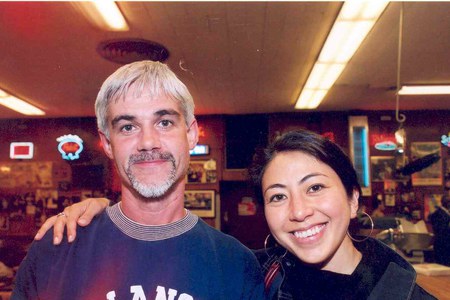
In 2002, 15 years after Bruce Godschalk was convicted of two rapes in Montgomery County, Pennsylvania, he was exonerated by DNA testing. The testing proved that a confession obtained by police from Mr. Godschalk was false.
The Crime
In the early morning hours of July 13, 1986, a man broke into the apartment of a 46-year-old woman in King of Prussia, Pennsylvania. The man raped the woman in her bedroom and fled.
On Sept. 8, 1986, a 32-year-old woman in the same apartment complex was raped during the early morning hours. In both instances, the women were taken to the hospital where rape kits were taken.
The Investigation
The second woman worked with police to create a composite sketch of her attacker. The sketch was broadcast on television and printed in the newspapers.
On Dec. 30, 1986, Upper Merion Township police received a telephone call from a woman who said that 26-year-old Bruce Godschalk, a local unemployed landscaper, resembled the sketch. On Jan. 13, 1987, Mr. Godschalk went to the police station voluntarily to be interrogated.
After less than an hour of questioning, police said that Mr. Godschalk confessed to both crimes. Both victims also identified him as their attacker in photographic lineups.
Mr. Godschalk was arrested that day and charged with two counts of forcible rape and two counts of burglary.
The Trial
In May 1987, Mr. Godschalk went to trial in the Montgomery County Court of Common Pleas. Both women identified him as their attacker. The prosecution presented the recording of his confession.
A man who had been in jail at the same time that Mr. Godschalk awaited trial testified that Mr. Godschalk had confessed to the crimes.
A serologist testified that Mr. Godschalk could not be eliminated as the source of the semen found in the rape kit.
Mr. Godschalk testified and denied committing the crime. He stated that his confession was false and was made while he was intoxicated. The police had threatened him and provided details to make the confession more credible.
The defense also presented witnesses who asserted that — in contrast to the victims’ testimony that their attacker was clean-shaven — Mr. Godschalk had facial hair at the time of the crimes.
On May 29, the jury convicted Mr. Godschalk on two counts of burglary and two counts of forcible rape. He was sentenced to 10 to 20 years in prison.
His conviction was upheld on appeal.
The Exoneration
In 1995, Mr. Godschalk contacted the Innocence Project. Four years later, the Innocence Project obtained a copy of the taped confession. The tape was sent to an expert, who concluded that it was likely that Mr. Godschalk had falsely confessed.
During that time, the Montgomery County District Attorney’s office opposed release of the physical evidence for DNA testing. A motion for release of the evidence was denied in June 1995. The defense, represented by attorney David Rudovsky and Innocence Project attorneys Peter Neufeld and Barry Scheck, appealed. In July 1996, the Pennsylvania Superior Court affirmed the lower court’s denial.
In November 2000, the legal team filed a federal civil rights complaint seeking access to the evidence.
As part of this litigation, the prosecution reported that it had sent the evidence to a laboratory for testing, which had not been able to obtain results. Moreover, the prosecution asserted that all of the evidence had been consumed in this testing.
When the defense noted that a carpet sample with semen had never been sent to the laboratory, the prosecution argued that the carpet sample had not been introduced as evidence and was not significant to the case.
The police officer who had obtained Mr. Godschalk’s confession had been responsible for the delivery of the evidence to the laboratory. He had also been the officer who had removed the carpet from the crime scene.
However, the carpet sample was discovered in October 2001. One month later, U.S. District Judge Charles Weiner ordered testing be conducted. “While [Godschalk’s] detailed confessions to the rapes are powerful inculpatory evidence, so too any DNA testing that would exclude [Godschalk] as the source of the genetic material taken from the victims would be powerful exculpatory evidence,” the judge declared.
The evidence was sent to two private laboratories. On Jan. 16, 2002, Forensic Science Associates in California reported that Mr. Godschalk was excluded as the source of the semen. Two weeks later, Orchid Cellmark in Maryland confirmed these findings..
Both laboratories reported that the same male DNA profile was obtained from the rape kits for both women.
The District Attorney still resisted, arguing that the confession trumped the testing, and sent the evidence to a third laboratory. That testing once again confirmed that Mr. Godschalk was excluded.
On Feb. 14, 2002, Montgomery County District Attorney Bruce Castor Jr. asked Judge S. Gerald Corso to vacate Mr. Godschalk’s convictions. That same day, Mr. Godschalk was released from prison. On Feb. 15, Judge Corso vacated the convictions and the charges were dismissed.
Subsequently, Mr. Godschalk filed a federal civil rights lawsuit that was settled for $2.4 million.
Time Served:
15 years
State: Pennsylvania
Charge: Forcible Rape (2 cts.), Burglary (2 cts.)
Conviction: Forcible Rape (2 cts.), Burglary (2 cts.)
Sentence: 10 to 20 years
Incident Date: 07/13/1986
Conviction Date: 05/29/1987
Exoneration Date: 02/14/2002
Accused Pleaded Guilty: No
Contributing Causes of Conviction: Eyewitness Misidentification, False Confessions or Admissions, Government Misconduct, Informants
Death Penalty Case: No
Race of Exoneree: Caucasian
Race of Victim: Caucasian
Status: Exonerated by DNA
Alternative Perpetrator Identified: No
Type of Crime: Sex Crimes
Year of Exoneration: 2002