Anthony Michael Green
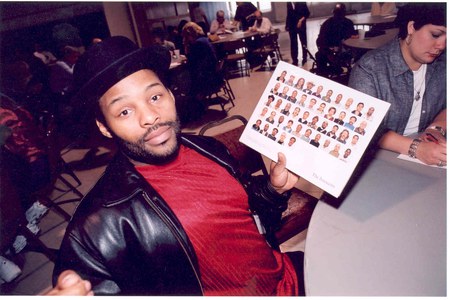
In October 2001, Anthony Michael Green was exonerated by DNA testing of a 1988 rape in Cleveland, Ohio, after being convicted on eyewitness misidentification. He was released after spending 13 years in prison. The actual perpetrator later confessed.
The Crime
On May 29, 1988, a 33-year-old white woman was attacked and raped in her room at the Cleveland Clinic Inn in Ohio, where she had been staying following treatment for liver cancer.
The woman had heard a knock at her door. When she opened it, a man grabbed her throat and held a knife near her face, demanding money. Once she gave him $40, he raped her. Following the assault, the assailant grabbed a washcloth from the bathroom and cleaned his penis. He then threw the washcloth on the floor and left, taking the radio.
Immediately afterwards, the victim went into the bathroom and washed herself. She tried to reach the Rape Crisis Center, but her call went unanswered. She then called the Cleveland Clinic security, which notified the Cleveland Police Department. Both agencies responded to the scene.
The victim initially described the assailant as a Black man, around 23 years old, 5 feet 8 inches tall, weighing 165 pounds, with brown eyes, a short Afro, and a pock-marked face with pimples. She said he wore a black ski cap type hat and a durag, as well as a black t-shirt with cut-off sleeves and gray pleated pants. During the attack, the perpetrator told her his name was Tony.
The police collected the washcloth and took the victim to Mount Sinai Medical Center, where a rape kit was prepared and pubic hair samples were collected.
The Investigation
Twenty-two-year-old Anthony Michael Green, a former employee of the Cleveland Clinic, became a suspect after a clinic security officer noticed that Mr. Green resembled the victim’s description.
Police showed the victim a photographic lineup of several young Black men, including Mr. Green. Looking at the photos, she said that one person resembled her attacker, “but just not enough.”
The next day, the victim was shown another photographic lineup. Each photo had a biographical placard that included the individual’s height, weight, and age. Mr. Green’s photo was the only one featured in both lineups, and his height, weight, and age fit the victim’s description. This time, she identified Mr. Green as her assailant.
The next week, after Mr. Green learned that he was wanted for questioning, he voluntarily went to speak with Cleveland Clinic security. He was then arrested.
On June 22, 1988, a Cuyahoga County grand jury indicted Mr. Green on one count of rape and one count of aggravated robbery.
The Trial
On Oct. 13, 1988, Mr. Green went to trial in the Cuyahoga County Court of Common Pleas. The prosecution’s case hinged on the cross-racial identification made by the victim, as well as serological testing of the washcloth.
Joseph Serowik, a civilian scientific examiner for the Cleveland Police Department Forensic Laboratory, was called to testify. He explained that he was able to determine, with scientific certainty, that the sperm came from a blood type B secretor — eliminating 84% of men as a possible source. Seeing as Mr. Green and the victim were type B secretors, he argued that Mr. Green could be the source, even though serological testing could not distinguish the victim’s profile from the assailant’s.
Mr. Serowik also testified that he had found Mr. Green’s pubic hair to be inconsistent with a hair found on the washcloth. Trace evidence expert Max Houck would later state, in a 2004 affidavit filed by Mr. Green’s legal team, that this should have precluded further examination of Mr. Green’s hairs.
However, instead of ceasing examination, Mr. Serowik had requested samples of Mr. Green’s chest and head hair. He then reported that the washcloth hair was “found to be consistent with the known hair sample” from Mr. Green “with respect to all of the characteristics considered.”
This was false, however. Mr. Serowik’s notes stated that the washcloth hair and Mr. Green’s hair “did not match,” as they “appear[ed] to be similar in all respects except root, length, and perhaps color.”
Still, at trial, he stated that the hairs matched, characterizing the probability of hairs from different people being consistent as 1 in 40,000 and “extremely remote.”
On Oct. 21, the jury announced that it had reached a verdict. However, the defense requested that the jurors be polled. When it was revealed there was disagreement among the jury, the judge sent them back to continue deliberations. Less than an hour later, they returned with guilty verdicts on both counts.
On Oct. 26, 1988, Mr. Green was sentenced to consecutive prison terms of 10 to 25 years on each count, for a total of 20 to 50 years in prison.
In March 1990, the Eighth District Court of Appeals of Ohio upheld the conviction. The defense contended that the photo arrays were suggestive, because Mr. Green had been the only person included in both lineups — but the appeals court rejected this claim.
The court also rejected the defense argument that the prosecutor had committed misconduct during closing arguments by calling Mr. Green a “fraud, a phone, and a liar,” and by pointing out that the defense did not call alibi witnesses — a tactic that improperly shifts the burden of proof onto the defendant. The court ruled that the defense had waived this argument by failing to object at trial, and that the remarks, while intemperate, did not deprive Mr. Green of a fair trial.
The Exoneration
In 1997, Mr. Green contacted the Innocence Project to assist in obtaining DNA testing to challenge his conviction. With the help of Mr. Green’s father, Robert Mandell, the physical evidence was located. On May 22, 2001, Judge Anthony O. Calabrese Jr. granted Mr. Green’s motion for testing based on an agreement signed by Mr. Green’s attorneys and the prosecution.
On July 9 of that year, Dr. Edward Blake, of Forensic Science Associates, received the washcloth. A large stained area on the washcloth had been marked and sampled in three areas during the Cleveland Police Department’s original examination. Dr. Blake selected five different sections of the stain for testing. The DNA profile obtained from these five sections excluded Mr. Green as the source of the sperm.
Aside from the DNA results, Dr. Blake asserted that Mr. Serowik’s trial testimony was scientifically irresponsible and misleading. Mr. Serowik had suggested that the stain on the washcloth was solely semen, when it was actually a mixture of semen and the victim’s vaginal secretions — something Dr. Blake said Mr. Serowik either knew or should have known. Furthermore, Mr. Serowik testified that only 16% of the population, or those with type B blood, could have contributed the stain. In fact, because the victim was a type B secretor, the sample could have come from any type B or type O secretor, or any nonsecretor — a far larger portion of the population.
Mr. Green was released on Oct. 9, 2001. On Oct. 18, based on the DNA test results, the prosecution agreed to vacate the conviction and dismiss the case. Mr. Green had been wrongfully incarcerated for 13 years.
After his release, the real perpetrator, Rodney Rhines, confessed and was convicted and sentenced to five years in prison.
In 2003, Mr. Green was awarded $552,000 in state compensation.
In June 2004, Mr. Green reached a $1.6 million settlement of a federal lawsuit filed against the city of Cleveland.
In that civil suit, Mr. Houck wrote an affidavit stating that Mr. Serowik had committed “professional and scientific misconduct in failing to accurately document, report, and corroborate his observations and conclusions in his hair casework.” Mr. Houck added, “This is true not only in the case at hand but in all of the cases I have reviewed of [Mr. Serowik’s].”
The city agreed not only to compensate Mr. Green, but to create and conduct the “Anthony Michael Green Forensic Laboratory Audit” of the city police laboratory to address the causes of faulty and falsified forensics, which played a large part in Mr. Green’s conviction. Mr. Serowik was fired.
In September 2017, Mr. Green, 52, graduated from Cuyahoga Community College’s Peace Officer Basic Training Academy.
Time Served:
13 years
State: Ohio
Charge: Rape, Aggravated Robbery
Conviction: Rape, Aggravated Robbery
Sentence: 20 to 50 years
Incident Date: 05/29/1988
Conviction Date: 10/21/1988
Exoneration Date: 10/18/2001
Accused Pleaded Guilty: No
Contributing Causes of Conviction: Eyewitness Misidentification, Unvalidated or Improper Forensic Science
Death Penalty Case: No
Race of Exoneree: African American
Race of Victim: Caucasian
Status: Exonerated by DNA
Alternative Perpetrator Identified: Yes
Type of Crime: Sex Crimes
Forensic Science at Issue: Flawed Serology, Hair Analysis
Year of Exoneration: 2001