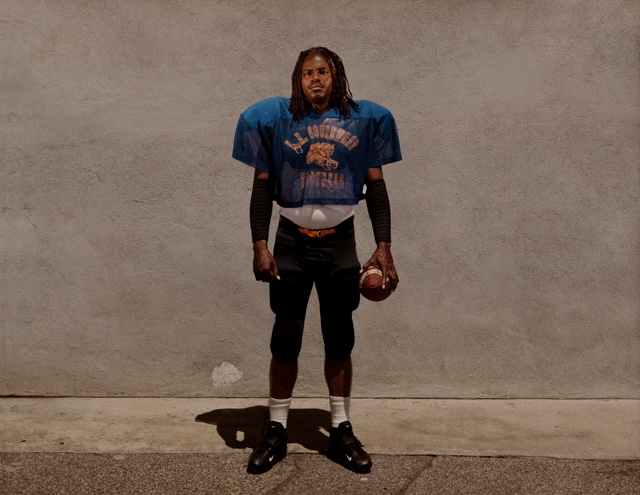
An emotionally revealing photograph of Herman Atkins in his college football jersey taken by the world renown photographer, Taryn Simon, for her book “The Innocents.” (Image: Taryn Simon)
Mr. Atkins showed up for every exoneree who needed a big brother, and he never stopped believing that people could be better than the worst thing done to them.
Obituary 10.29.26 By Peter Neufeld

Herman Atkins (Image: Courtesy of the Innocence Project)
Herman Atkins, who was exonerated in February 2000 died peacefully last Saturday, October 24, at his son Imari’s home in Houston, Texas. He was 61 years old and had suffered from pancreatic cancer for several years.
Always the great optimist, from the day he walked out of prison until the last weeks of his life, Mr. Atkins was a father of four sons, a colleague to all of us in the innocence movement, a big brother to — and enthusiastic supporter of — other exonerees struggling with the transition to freedom, and a loving friend to so many more.
Mr. Atkins was born on Sept. 17, 1965, near the Watts neighborhood in South Central Los Angeles — one month after the Watts riots, a six-day series of explosive demonstrations against decades of racist practices by the Los Angeles Police Department and a pattern of unrelenting racial discrimination in housing, employment, and education. Despite his family’s deep roots in Louisiana, his grandmother, Rosa Atkins, affectionately known as “Big Mama,” had moved their family to the area during the Second Great Migration, in search of new opportunities at the beginning of World War II. His parents, Florita Atkins and Lawrence Phillips split up when he was very young. He was raised by his mother and stepfather Elmer “Pops” Clark, a stern disciplinarian who had also migrated from the deep South to Los Angeles. One of the earliest Black officers hired by the California Highway Patrol, Pops taught Mr. Atkins to stay clear of gangs, stay in school, and always have a job.
A varsity football player, Mr. Atkins graduated with a solid academic record from Fremont High School, which was segregated at the time. He hoped to join the Air Force, secure a college education, and become a law enforcement officer like his stepfather. He worked as a mechanic to earn enough money for college.
Instead of being able to pursue his dreams, Mr. Atkins was wrongfully arrested, detained, and charged with an aggravated rape of a white woman he had never met in 1986. The crime had taken place in an overwhelmingly white town that he had never visited 100 miles away. He was wrongly convicted in 1988 based on two unduly suggestive cross-racial identifications, multiple Brady violations, and grossly misleading trial testimony by a serologist working for the California Department of Justice Riverside Laboratory.
Although Mr. Atkins maintained his innocence, his stepfather chose not to believe him, swayed by law enforcement colleagues that the case was solid. Not only did Pops never visit his stepson or write to him for 14 years, he lobbied Mr. Atkins’ mother to do the same.
In 1995, the Innocence Project took on Mr. Atkins’ case. Four years later, we discovered the rape kit and tested the biological evidence. Once he was excluded as the source of the semen deposited by the attacker, the district attorney, who was incredulous, had all the evidence re-tested by the FBI. After the agency reached the same exculpatory finding, a court vacated Mr. Atkins’ conviction, dismissed the indictment, and ordered his release on Feb. 17, 2000. In addition to his pre-trial detention, he had served 12 years of his 45-year sentence in state prison.
Mr. Atkins was disappointed that he never got his day in court for the adjudication of his innocence. Although the district attorney conceded the motion to vacate his conviction and dismiss the charges, he simply forwarded it to the accommodating judge. Our organization was never notified. Additionally, no hearing was held. Once prison officials received the judge’s order, Mr. Atkins was escorted to the exit, handed a few bucks, and told to find his own way home from the remote desert facility.
Immediately after his exoneration, Mr. Atkins hit the ground running. Within weeks of his release, Barry Scheck (my fellow Innocence Project co-founder) and I brought him to a scholarly conference on wrongful convictions at the University of California, Irvine where Mr. Atkins delivered a moving and thoughtful extemporaneous speech that brought down the house. At 34 years old, he enrolled in college to secure the degree that had eluded him after high school. Perhaps most amazingly, after weeks of punishing workouts, he made his college football team as a walk-on and started as a defensive end.
An emotionally revealing photograph of Herman Atkins in his college football jersey taken by the world renown photographer, Taryn Simon, for her book “The Innocents.” (Image: Taryn Simon)
During the first five years of his freedom, Mr. Atkins spent a portion of each day with his grandmother, who was a huge influence on him, until she died. Optimistic that his conviction would ultimately be overturned, she believed in him throughout his imprisonment and reminded him that “a lie will die and the truth lives on.” Mr. Atkins’ mother, Florita, lived only one year after his release, during which she left her husband and cut off all contact after realizing everything he had told her about Mr. Atkins was false and had cost her 14 years with her son. Nevertheless, Mr. Atkins ultimately — and for me inexplicably — forgave his stepfather.
On the anniversary of his release in 2006, Mr. Atkins married Machara Hogue in a wedding covered by the New York Times. Together, they founded Life Intervention for Exonerees, a non-profit that presented other exonerees with welcome-home baskets. Five years later, he and Ms. Hogue divorced, but the two remained friends until his death.
Recognizing the profound injustice that Mr. Atkins had endured, our law firm, Cochran Neufeld & Scheck (subsequently, Neufeld Scheck Brustin Hoffman & Freudenberger, LLP), filed a civil right lawsuit against the Riverside Sheriff’s Department in what would become a lengthy battle. The case was assigned to Judge Percy Anderson, a district judge who was known for dismissing more civil rights cases than any other judge in the Ninth Circuit. He eventually cut the evidence-gathering phase short and dismissed the case in favor of the defendants before it could go to trial. Fortunately, the U.S. Court of Appeals for the Ninth Circuit reinstated the case against the Riverside Sheriff’s deputy responsible for fabricating evidence and the Brady violations. The case went back to Judge Anderson for trial, who expressed his anger that he had been reversed. During a two-week jury trial, the Ninth Circuit overruled his rulings four times after Mr. Atkins filed emergency appeals. When the jury returned with a question during their deliberations that strongly suggested they were leaning toward Mr. Atkins, Judge Anderson declared a mistrial on his own initiative, over the objection of both sides. Judge Anderson was removed for the re-trial, and a second jury returned a verdict for Mr. Atkins and awarded damages.
The satisfying ending to this litigation slugfest nudged Mr. Atkins toward contemplating a career in social justice law. Justin Brooks, who was then the director of the California Innocence Project and a professor at the California Western School of Law in San Diego, helped him get into law school and personally tutored him. Despite Mr. Brooks’ mentorship, it was not enough to keep Mr. Atkins in law school. He found key legal principles completely alien — particularly the law’s reliance on precedent over evolving science, and rigid mandatory sentencing that left little room for empathy or mitigating circumstances.
For the rest of his life, Mr. Atkins continued to help other exonerees, rehabilitated dilapidated housing to make them livable and affordable, mentored his sons, and coached Little League. He even found a way to use his passing experience with DNA to earn a living, raising French bulldogs and carefully pairing each generation to nurture the breed’s strongest, healthiest traits. Genetics saved Mr. Atkins’ life and ultimately offered a way for him to rebuild his life.
I knew Mr. Atkins for more than three decades. In all that time, I never saw him let what was taken from him turn into bitterness. He forgave people I could not. He showed up for every exoneree who needed a big brother, and he never stopped believing that people could be better than the worst thing done to them. He is survived by his four sons, including Imari Atkins, Herman Clayton Atkins, Enrique Prince, and Kingston Atkins.
Listen to two National Public Radio StoryCorps recordings: the first, a conversation between the author and Mr. Atkins several years ago, shortly before he was diagnosed with stage four pancreatic cancer; the second, a conversation between Mr. Atkins and his son, Imari, which was recorded last year after several rounds of chemotherapy.
Leave a Reply
Thank you for visiting us. You can learn more about how we consider cases here. Please avoid sharing any personal information in the comments below and join us in making this a hate-speech free and safe space for everyone.