Scott Fappiano
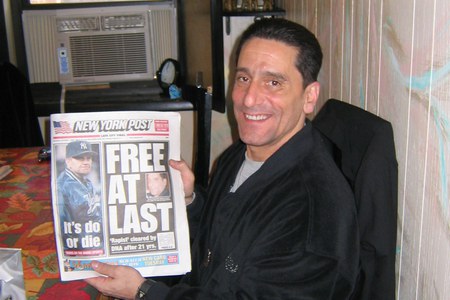
In October 2006, Scott Fappiano was exonerated of a 1983 rape in Brooklyn, New York. DNA testing excluded Mr. Fappiano as the source of biological evidence in the case. He had spent more than 20 years in prison for a crime he did not commit.
The Crime
At about 1 a.m. on Dec. 1, 1983, an armed man broke into an apartment in Brooklyn, New York. The man tied up F.S., a New York City police officer, with a telephone cord. The man then sexually assaulted F.S.’ wife, T.S.
During the 40 minute attack, the perpetrator stopped to smoke a cigarette and drink beer. After the assault, T.S. asked to use the bathroom. She wrapped herself in a towel and ran out of the apartment. The attacker grabbed his jacket and fled. T.S. returned to the apartment and untied her husband. They called 911 and reported that an officer needed assistance.
The Investigation
T.S. would later testify that approximately 50 officers arrived at the apartment. T.S. was taken to Lutheran Medical Center, where a rape kit was taken. A few hours later, she told Detective Clyde Dunbar that the assailant was about 5 feet 10 inches tall, weighed 160 pounds, and had dark hair and an olive complexion. She said he was soft-spoken, with jeans, a black leather jacket, and keys that kept jangling from his belt. Her husband was unable to give a description.
After meeting with Detective Dunbar, T.S. met with Detective Frank Sciallo, who showed her mugshots. T.S. did not identify anyone. Detective Sciallo would later say he told Detective Dunbar about the viewing, although the results were not included in Detective Dunbar’s report.
Around 8 a.m., several hours after the attack, T.S. met with Detective Helene Gottlieb, the lead investigator specializing in sex crimes. Detective Gottlieb would later say that T.S. was very precise and detailed in her description of the assailant.
T.S. was then shown a photo lineup, which was organized by height, age, and race. She selected one photo, put it aside, then selected another photo. Both photos were of 21-year-old Scott Fappiano. Detective Sciallo would later give conflicting accounts of whether T.S. had seen a photo of Mr. Fappiano during their initial meeting. In one account, he said she had; in the other, he said that she hadn’t.
Mr. Fappiano was already known to Detective Gottlieb and the sex crimes unit. He had been previously arrested on a rape charge and acquitted at trial, in part because the victim in that case had not mentioned Mr. Fappiano’s extensive tattoos on both legs. Detective Gottlieb’s report detailing her interview with T.S. also did not include any reference to tattoos. In addition, Mr. Fappiano was only 5 feet 5 inches tall, shorter than T.S.’ description of the attacker.
The police collected evidence from the crime scene on two separate visits. The first occurred at 3:25 a.m. on Dec. 1, about an hour and a half after the perpetrator fled the apartment. Two officers took photographs and dusted for fingerprints, collecting 12 usable prints. They identified T.S. as the source of two of the prints. Mr. Fappiano was excluded as a source of the others.
Later that day, T.S. and F.S. returned to the apartment with Detective Gottlieb. They collected a bottle opener and beer cap, the jogging pants worn by T.S. prior to the rape, a bra the assailant had put in his mouth, a brown towel and a white towel, and the bed sheets. They also collected five cigarette butts. Detective Gottlieb would note in her report: “Cigarette butts allegedly smoked by the perpetrator were recovered.”
The police department’s crime laboratory conducted forensic testing on the evidence. At the time, DNA testing was unavailable, but forensic analysts could test for the presence of semen and for blood type.
At that time, the laboratory tested for semen by conducting an acid phosphatase test. While it was possible to just test part of the sample, the department’s general practice was to submerge the entire sample into the acid phosphatase. This method corrupted the sample and prevented blood typing. Dr. Robert Shaler, the director of serology at the New York City Office of the Chief Medical Examiner, had previously warned the department about the flaws in this approach, but the practice persisted.
A forensic analyst tested the rape kit, jogging pants, bra, towels, and bed sheets, and detected sperm in the rape kit, jogging pants, and the white towel.
Four days after the attack, T.S. and F.S. looked at photo arrays after an assistant district attorney mentioned another man with a criminal record who resembled Mr. Fappiano. T.S. looked at an array that included the other man, but did not include Mr. Fappiano. She did not select anyone. F.S. looked at an array that included both men, and selected Mr. Fappiano.
The police conducted a live lineup the next day. Mr. Fappiano came in voluntarily, and T.S. selected him as the assailant, noting his position as number 4 in the six-person lineup. Prior to F.S. viewing the lineup, Mr. Fappiano switched seats. F.S. first selected number 4, but his selection was crossed out and switched to another number. T.S.’ viewing was recorded; F.S.’ was not.
Police arrested Mr. Fappiano later that day. A grand jury indicted him on charges of first-degree rape, first-degree sodomy, first-degree sexual abuse, first-degree burglary, first-degree unlawful imprisonment, and criminal use of a firearm.
After Mr. Fappiano’s indictment, Dr. Shaler conducted blood testing. He reported that the saliva on the cigarettes and the semen on the towel were blood type A, which matched F.S. but not Mr. Fappiano, who was blood type O. The jogging pants did not have sufficient material to test based on the technology available at that time.
The Trial
Prior to the start of Mr. Fappiano’s trial in Kings County Supreme Court, Justice Philip Lagana held a hearing to determine whether to allow the introduction of T.S.’ and F.S.’ identifications of Mr. Fappiano. Justice Lagana said T.S. could testify about her identification, but her husband could not.
The trial began in November 1984. No forensic or physical evidence connected Mr. Fappiano to the attack.
T.S. testified and identified him as her assailant. She explained that she had not noticed whether her assailant had any tattoos on his legs, because he never took off his pants. She also testified that the white towel, which excluded Mr. Fappiano as a contributor to the blood sample, had never been touched by the assailant. The semen sample, she clarified, was from a few days earlier, when she and her husband had sex. There was nothing in Detective Gottlieb’s notes indicating the irrelevance of the white towel, but T.S. testified that she and Detective Gottlieb had argued briefly when the detective was collecting evidence, and that she had told Detective Gottlieb that the white towel had nothing to do with the crime.
Two detectives testified that the lack of evidence connecting Mr. Fappiano to the crime scene was due to contamination during the investigation. Many officers had been in the apartment. Some of them had been smoking and their cigarettes could have been in the ashtray. They said the cigarettes, which had been collected after the apartment had been dusted for fingerprints, contained no dust, which indicated contamination. In addition, T.S. and F.S. both testified that the assailant didn’t actually smoke a whole cigarette, but only took a few puffs of a Newport.
The jury deliberated for two days, but after reporting it was deadlocked at 11 to 1 for acquittal, Justice Lagana declared a mistrial.
Mr. Fappiano’s second trial began in August 1985. T.S. denied having a conversation with Detective Gottlieb about the white towel. This time, she said she didn’t realize the police had this item until a prosecutor told her.
At the first trial, Mr. Fappiano’s attorney had cross-examined Detective Gottlieb about the lineup report with the crossed-out numbers. At the second trial, Detective Gottlieb again testified that she had not tampered with the card, but Mr. Fappiano’s attorney was unable to cross-examine Detective Gottlieb as effectively, because the lineup card was missing.
The jury convicted Mr. Fappiano on Aug. 15, on five counts of first-degree rape, two counts of first-degree sodomy, one count of first-degree burglary, and one count of first-degree sexual abuse. Mr. Fappiano was sentenced to between 20 years and 10 months, and 50 years in prison.
Mr. Fappiano appealed his conviction, arguing that the lineups had been “impermissibly suggestive.” The Second Department of the Supreme Court’s Appellate Division rejected his appeal in 1988, noting the length of time that T.S. saw her assailant.
The Exoneration
In 1989, after the first DNA exoneration in the United States, Mr. Fappiano obtained a court order to conduct DNA testing on the physical evidence in his case. The police department was unable to produce the white towel and the brown towel, the bed sheets, the bra, and the cigarette butts. However, the district attorney’s office still had the rape kit and the jogging pants.
These items were sent to LifeCodes, a DNA laboratory. When LifeCodes opened the package, the rape kit was empty and the swabs were missing. Analysts at the company tried to test the jogging pants, but they contained an insufficient amount of genetic material to provide a profile. The items were returned to the district attorney’s office, although LifeCodes kept a DNA extract of the sample from the jogging pants.
In 2003, the Innocence Project began representing Mr. Fappiano, and two years later, located the DNA extract from the jogging pants at Orchid Cellmark, another DNA laboratory that had received LifeCodes’s samples after the latter went out of business. Analysts with the Office of the Chief Medical Examiner tested the extract, and discovered that it contained a male and female contributor of genetic material. T.S. was the female. F.S. and Mr. Fappiano were excluded as contributors to the male sample.
On Oct. 6, 2006, the Kings County District Attorney consented to a defense motion to vacate Mr. Fappiano’s conviction. His charges were dismissed that day, and he was released.
In 2007, Mr. Fappiano filed a civil rights lawsuit in U.S. District Court for the Eastern District of New York against the city of New York and several of the officers involved in his case.
The lawsuit stated that the police had created the claim of crime scene contamination after the forensic evidence had excluded Mr. Fappiano. It also claimed that Detective Gottlieb had aided in perjury by getting T.S. to change her testimony. Additionally, the lawsuit said that Detective Sciallo had told prosecutors that T.S. hadn’t picked Mr. Fappiano when she looked at photos that second time, and that prosecutors failed to disclose that information to Mr. Fappiano’s defense.
Judge Townes dismissed Mr. Fappiano’s lawsuit against the city on Jan. 7, 2015. Separately, Mr. Fappiano received $2.5 million in state compensation in 2009. He passed away in December 2016 after battling lung cancer. He was 55 years old.
Time Served:
21 years
State: New York
Charge: First-degree Rape, First-degree Sodomy, First-degree Sexual Abuse, First-degree Burglary, First-degree Unlawful Imprisonment, Criminal Use of a Firearm
Conviction: First-degree Rape (5 cts.), First-degree Sodomy (2 cts.), First-degree Sexual Abuse, First-degree Burglary
Sentence: 20 to 50 years
Incident Date: 12/01/1983
Conviction Date: 12/15/1985
Exoneration Date: 10/06/2006
Accused Pleaded Guilty: No
Contributing Causes of Conviction: Eyewitness Misidentification, Government Misconduct, Unvalidated or Improper Forensic Science
Death Penalty Case: No
Race of Exoneree: Caucasian
Race of Victim: Caucasian
Status: Exonerated by DNA
Alternative Perpetrator Identified: No
Type of Crime: Sex Crimes
Forensic Science at Issue: Flawed Serology, Other
Year of Exoneration: 2006