Carmen Mejia
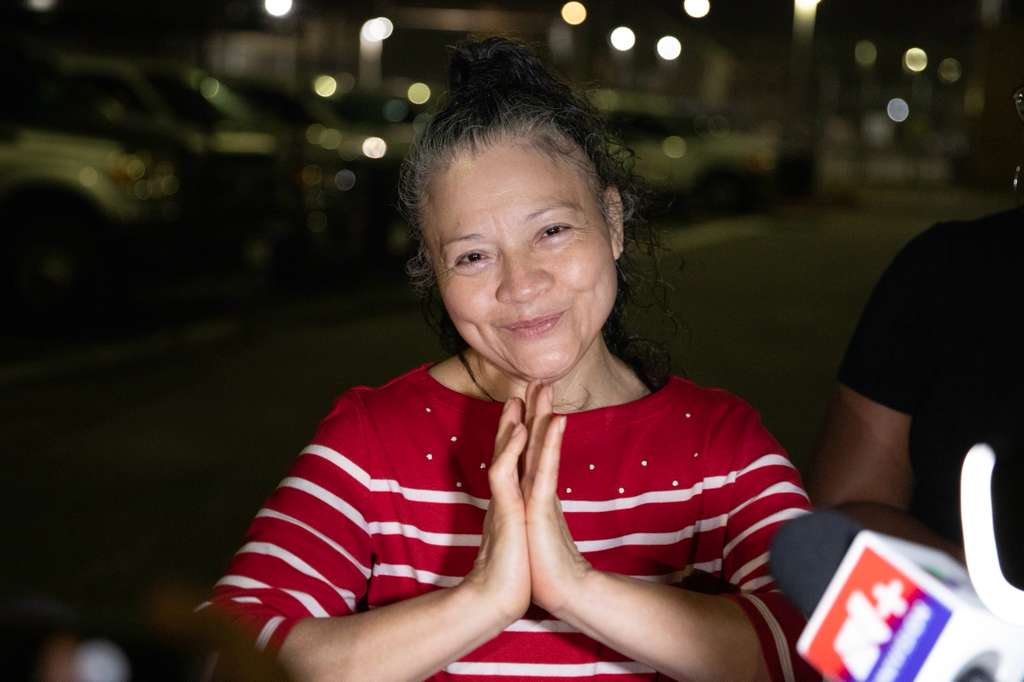
On March 9, 2026, Carmen Mejia was exonerated more than 22 years after she was arrested and convicted of murder in Austin, Texas. Ms. Mejia had been wrongly convicted of causing the death of a 10-month-old baby by immersing the child in scalding water.
The Crime
On the morning of July 28, 2003, 10-month-old Abelardo Casiano suffered severe burns from scalding water in a bathtub at an apartment in Austin, Texas, where he lived with his father, Mauro Casiano. Also living there were 31-year-old Carmen Mejia with her four young children, and her common-law husband, Jose Bonilla.
Ms. Mejia later said that after she saw Abelardo in the water, she grabbed him and “put cold water all over him,” a burn treatment she had learned growing up in Honduras.
With her children, she drove Abelardo to the North Lamar Family Clinic, which was five miles away. There she was told they could not treat the child. Ms. Mejia left and ultimately arrived at St. David’s Hospital around 1:30 p.m.
Physicians at St. David’s transferred Abelardo to Brackenridge Children’s Hospital at 5:30 p.m. He was pronounced dead at 9:48 p.m.
The Investigation
Ms. Mejia had told a social worker at St. David’s that Abelardo had burned himself by pulling a pot of boiling water on himself.
At 11:22 p.m., Detective Rogelio Sanchez brought Ms. Mejia to the police station for questioning. She was interrogated for the next 14 hours.
Ms. Mejia initially repeated that Abelardo pulled a pot off the stove. When Detective Sanchez told her that was inconsistent with Abelardo’s injuries, Ms. Mejia said that Abelardo had climbed into the tub on his own. Mr. Casiano, the boy’s father, was also at the police station, and he told Detective Sanchez that his infant son wasn’t yet able to do that.
Ms. Mejia then said Mr. Casiano had raped her and put his son in the tub after she had rejected his sexual advances. When Detective Sanchez said that Mr. Casiano had an alibi, Ms. Mejia said that Abelardo had been burned in the tub when one of her daughters accidentally turned on the hot water. Unlike most of the interview, this final portion was not recorded.
Austin police officers went to the duplex and recorded the bathroom tap water had a top temperature of 147.8 degrees. The duplex’s water heater, which lacked a safety control to prevent scalds, was set between 140 and 150 degrees.
Forensic interviewers at the Children’s Advocacy Center interviewed Ms. Mejia’s three oldest children: Jose, who was 6 years old; Anna, who was 4 years old; and Jennifer, who was 2 years old. During the interviews, which were recorded, the children gave various accounts, but they never said that their mother was in the bathroom when Abelardo was scalded. The videotapes were turned over to the police.
Dr. Elizabeth Peacock, the deputy medical examiner for Travis County, performed the autopsy on July 29. She noted scalding on the lower part of Abelardo’s body, including the burns on his arms in a “glove-like configuration.” She also noted a bruise on the front of his head but said that there was no evidence of bleeding inside the brain. At that time, Dr. Peacock had only been given Ms. Mejia’s initial statement that Abelardo had pulled a pot of hot water off the stove. In her July 30 report, Dr. Peacock wrote that “based on the anatomic findings at autopsy, and investigation available to me at this time,” Abelardo died because of burn injuries. She ruled his death a homicide.
Ms. Mejia was arrested on July 29, 2003, and charged with felony murder, injury to a child with serious injury, and injury to a child by omission. Her children were placed in foster care.
The defense hired a forensic expert. However, the expert was not a medical professional and had no experience or expertise in burn care or analysis. Although he concluded that “burn patterns are not consistent with someone intentionally forcing the baby into the hot water and intentionally causing the baby bodily injury,” the defense never called him to testify.
In April 2005, the state reported that the video recordings of the Mejia children had been “lost.” No transcripts existed, only summaries.
The Trial
Ms. Mejia went to trial in Travis County District Court on September 14, 2005. Judge Mike Lynch granted a prosecution motion to prevent the defense from introducing any evidence that any “one or more of [Ms. Mejia]’s children may have admitted causing the victim’s injury, or may have seen someone else cause the victim’s injury, or may have seen the victim cause his own injury.”
Detective Sanchez testified about the investigation and his interrogation of Ms. Mejia. He said that she finally said that she found Jennifer alone in the bathroom.
Phylip Peltier, an investigator and retired police officer, testified as an expert on burn injuries. He said he had “pioneered” a technique that allowed him to re-create burn injury patterns using blue clothing dye. “Every single splash, every single dot of water leaves a mark,” he said, which helped him determine the child’s position at the time of the injury.
Mr. Peltier testified that Abelardo was “held in the water,” not “placed in the water and just left there.” He said Abelardo suffered an immersion burn, which he said was caused by a person or part of a person being immersed in a scalding liquid. These burns left a “distinct border … that indicates to you a water line.”
Mr. Peltier said Abelardo had areas without burns under his armpits, which indicated he “was held and stabilized by somebody placing a hand under each of his armpits.”
Mr. Peltier also said Jennifer or Anna couldn’t have caused the injuries because they wouldn’t have been able to hold Abelardo still without burning themselves.
Dr. Peacock did not testify, but Dr. Roberto Bayardo, the chief medical examiner for Travis County, testified the injuries were inconsistent with Abelardo pulling a pot of hot water on himself or crawling into the bathtub and landing in hot water.
Dr. Keith Kerr, a pediatric intensive-care physician at Brackenridge, had treated Abelardo at St. David’s and at Brackenridge. Dr. Kerr said, “The injuries are classic for a child being held down in the bathtub … I have no doubt that this child was purposefully pushed down into the bathtub with the intention of harming the child.”
In addition, Dr. Kerr testified that the bruise on Abelardo’s head was a “major blow” that pointed toward “physical abuse.” He added that Ms. Mejia’s other children wouldn’t have been able to put Abelardo in the bathtub.
Ms. Mejia testified that she did not harm Abelardo and was not in the bathroom when he was burned. She said she loved Abelardo and that her children were playful and physical with the boy. She said they carried him around the house, put him on the bed, and sat with him to watch television.
Ms. Mejia said she was in her bedroom nursing her youngest child when Jennifer came in and told her to go to the bathroom. There, she said, she found Abelardo in the tub and Anna standing nearby. She said she quickly pulled Abelardo out and applied cold water. She recounted how she took Abelardo to the clinic, was turned away, and then went to the hospital.
Ms. Mejia said she initially lied to Detective Sanchez about what happened because she was terrified of losing her children and was traumatized, having not slept or eaten in hours. She also said that she had a fear of the police based on her experiences in Honduras. She said she finally told him the truth, that Anna was in the bathroom when Abelardo was burned in the tub.
Ms. Mejia’s three oldest children testified via closed-circuit television. None of them said Ms. Mejia had harmed Abelardo.
Three forensic interviewers at the Children’s Advocacy Center testified for the defense. They said none of the children implicated Ms. Mejia.
During closing arguments, the defense told the jury that there were “four very active young children at home at the time that this injury happened. It could have been one of them. These children are too young to be capable of this kind of evil. It was an accident. Accidents happen.”
On September 27, 2005, the jury convicted Ms. Mejia on all three charges. The next day, the jury sentenced her to three terms of life in prison, with the sentences running concurrently.
The Exoneration
A three-judge panel from the Texas Court of Appeals, Third District, affirmed her conviction on May 29, 2008.
In August 2014, Ms. Mejia filed a state petition for a writ of habeas corpus. The motion said, in part, that Ms. Mejia had received ineffective representation because the defense did not present expert testimony about scalding burns. The Texas Court of Criminal Appeals denied the petition in October 2014.
In 2015, Art Guerrero, the bailiff at Ms. Mejia’s trial, reached out to the Innocence Project. He had observed the trial, had seen Ms. Mejia’s demeanor, and had been troubled by the conviction. In 2021, the organization began representing Ms. Mejia.
On Aug. 30, 2024, Ms. Mejia filed a second state petition for a writ of habeas corpus. She was now represented by Vanessa Potkin and Timothy Gumkowski of the Innocence Project, later joined by Shabel Castro. In addition, the Conviction Integrity Unit (CIU) of the Travis County District Attorney’s Office was also re-investigating Ms. Mejia’s conviction and had discovered evidence that supported her habeas claims.
At a series of hearings before Judge P. David Wahlberg in late 2024 and early 2025, Ms. Mejia’s habeas team presented evidence that Abelardo’s death was a tragic accident.
Anna testified that she was “like a hundred percent” certain that she turned on the hot water in the bathtub. Jose and Jennifer were also in the bathroom with her, Anna said, but her mother was not there. Anna testified that the accident had haunted her for years. She said as a teenager she related her feelings of guilt to her adoptive mother who told her that it was not her fault; she was just a child.
Dr. James Gallagher, the director of the William Randolph Hearst Burn Center in New York, testified that there was no evidence that Abelardo’s injuries were the result of an intentional act by an adult. The injuries were consistent with an accidental burn, Dr. Gallagher said.
Because of the extremely high temperature of the hot water, Abelardo could have received life-threatening burns in a matter of seconds, Dr. Gallagher said, and the symmetrical appearance of the burns did not indicate abuse or intent.
At the request of the prosecution, Dr. Peacock reevaluated and changed the cause of death from homicide to accident. Dr. Peacock testified she had initially relied on the discrepancy between Ms. Mejia’s first explanation — that Abelardo had pulled a pot of hot water down from the stove — and the burn patterns she observed at the autopsy. She testified that she was not aware at the time of the water temperature settings at the duplex or that one of Ms. Mejia’s children had said she had turned on the hot water.
Dr. Kerr and Mr. Peltier did not testify at the hearings, but each submitted affidavits that recanted much of their trial testimony.
In a motion filed on June 11, 2025, after the evidentiary hearings, Ms. Mejia’s attorneys said she had been wrongfully convicted based on false or misleading testimony by the state’s expert witnesses.
In a response filed July 10, 2025, the state agreed.
On Sept. 26, 2025, Judge Wahlberg recommended that the Texas Court of Criminal Appeals grant Mejia’s habeas petition. In his 107-page recommendation and findings of fact, Judge Wahlberg wrote that Mejia’s “trial was infected with constitutional error, that scientific evidence relied on by the State at Applicant’s trial has now been contradicted by relevant scientific evidence, and that Applicant is innocent of the crimes for which she was convicted and has been imprisoned for the past 22 years.”
On January 22, 2026, the Court of Criminal Appeals granted Mejia’s writ on grounds of actual innocence.
Judge Wahlberg granted the state’s motion to dismiss the case at a hearing on March 9, 2026.
After the dismissal, Ms. Mejia was briefly held under a detainer through U.S. Immigration and Customs Enforcement, because her legal status to remain in the United States had expired while she was in prison. The agency lifted the detainer on March 10, 2026.
Time Served:
22 years
State: Texas
Charge: Felony Murder, Injury to a Child With Serious Injury, Injury to a Child by Omission
Conviction: Felony Murder, Injury to a Child With Serious Injury, Injury to a Child by Omission
Sentence: Life
Incident Date: 07/28/2003
Conviction Date: 09/27/2005
Exoneration Date: 03/09/2026
Accused Pleaded Guilty: No
Contributing Causes of Conviction: Unvalidated or Improper Forensic Science
Death Penalty Case: No
Race of Exoneree: Latinx
Race of Victim: Latinx
Status: Exonerated by Other Means
Type of Crime: Homicide-related
Forensic Science at Issue: Other
Year of Exoneration: 2026